Public petition dashboard · Statesboro, Georgia

Protect Statesboro Neighborhoods.

No Data Centers in Statesboro.

A transparent view of community support for denying final approval of the proposed Burkhalter Road data center and protecting Statesboro neighborhoods from future data center development.

Sign the Petition
Active petition signatures

Signers near the proposed site

01

City Council districts

Active signatures verified inside city limits

City-limit and council-district totals include addresses verified to date. Address review is ongoing, while all active signatures remain included in the overall petition total. Districts are assigned only after an address is verified inside Statesboro city limits.

02 Proposed Site

The Proposed Burkhalter Road Data Center

6539 Burkhalter Road · Statesboro, Georgia · City Council District 5

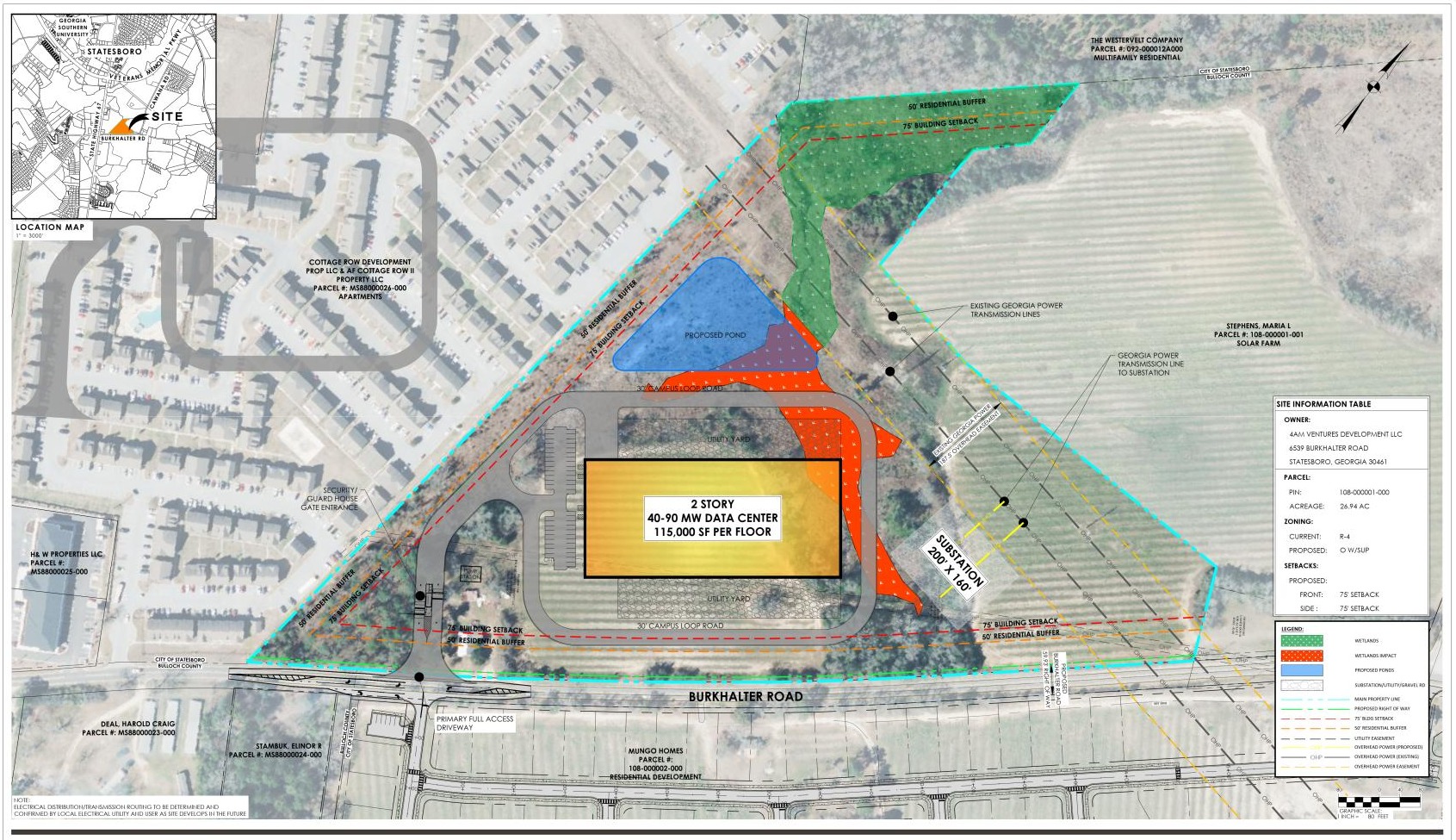
Official concept plan for the proposed Burkhalter Road data center, showing the two-story building footprint, loop road, electrical substation, detention pond, setbacks, buffers, and parcel boundaries.
The applicant's concept plan shows the proposed building footprint, access road, substation, detention pond, buffers, and parcel boundaries. It is not a final construction drawing.

03 Before Final Approval

WHAT REMAINS TO BE DISCLOSED

Rezoning did not grant final project approval. Before considering the required Special Use Permit, residents should be able to review the final operator, operating design, permit data, and public costs.

01

Named Operator and Final Design

The developers stated that no data center operator or technology company had been selected. Without an operator, the final computing equipment, cooling system, generator fleet, staffing, and operating practices remain unknown.

Questions for Council

Will Council wait for a named operator and final operating design? Will a later change in operator, cooling technology, generator fleet, or electrical demand require a new public hearing?

02

Backup Generators and Air Permitting

The current application does not disclose the number, size, fuel type, placement, or expected testing schedule of backup generators. EPA identifies stationary engines as common backup power sources subject to air requirements.

Questions for Council

How many generators are proposed? Where will they and their fuel tanks be located? Has Georgia EPD received an air permit application, and will emissions modeling include nearby homes?

03

Independent Nighttime Noise Model

Statesboro's ordinance uses existing ambient sound or 50 dBA and 70 dBC at a sensitive receptor's property line, whichever is greater. The time, location, traffic, and weather conditions used to establish the baseline can affect the enforceable limit.

The applicant's own noise consultant's finished survey (August 12, 2026) already measured every tested location exceeding the 70 dBC limit, one location by nearly 25 dB. This is ambient/existing noise data, collected before the facility exists. Two earlier report versions of the same field test (May and July 2026) did not evaluate the dBC threshold at all — only the August version checks the finished ordinance's full standard.

Questions for Council

Will an independent study measure the quietest nighttime conditions, low-frequency and tonal sound, upper-story residences, and all cooling, transformer, and generator sources operating together? Given that ambient sound already exceeds the ordinance's dBC threshold at every tested location, what does that mean for the enforceable limit once the facility adds its own noise on top?

04

Wetland Decision and Final Drainage Plan

The City report identifies wetlands on the property and states that the site remains under U.S. Army Corps of Engineers review. The concept plan places a detention pond near the residential side of the property.

Questions for Council

Will Council wait for the final wetland determination and permit path? How much wetland may be affected, where will the detention pond discharge, and which properties are downstream?

05

99 MW Power Request and Service Agreement

The concept plan identifies a 40 to 90 MW requirement, while the developer said it applied to Georgia Power for as much as 99 MW. No project-specific service agreement or required off-site upgrades have been disclosed. A Georgia Open Records Act response from the Georgia Public Service Commission (September 1, 2026) confirms no filing, docket, customer record, or contract number exists for this address at all — the only documented step so far is an informal Georgia Power intake letter acknowledging the project entered evaluation.

Georgia Power's data-center contracts are now reviewed under a statewide Public Service Commission framework meant to keep large-load customers from shifting costs onto residential ratepayers. The seventh contract approved under that framework, a 3.2-gigawatt agreement with OpenAI in Effingham County approved August 27, 2026, includes a commitment that Georgia Power cannot recover lost revenue from residential and small-business customers if the data center leaves early, a 15-day PSC notification requirement for early termination, and a pledge of $15 a month in downward pressure on average residential bills starting in 2029. Consumer advocates note these protections rest on assumptions that may not hold, and no operator has been named for this project, so it is not yet known whether its Georgia Power contract would include the same terms.

Questions for Council

Has Georgia Power accepted the request? What infrastructure must be built, who will pay for it, and what financial protections apply if the developer or future operator abandons the project? How will Council ensure that the reported 99 MW request—just below Georgia's 100 MW threshold—includes equivalent protections for existing ratepayers? Will Council require that any Georgia Power service agreement for this project include the same ratepayer protections approved for other large Georgia data-center contracts, made public before a Special Use Permit vote?

06

Complete Public-Cost Analysis

Georgia's own state auditor found that the economic-impact figures used to justify the state's data center tax exemption were overstated by roughly two-thirds, and concluded that about 70 percent of data center investment in Georgia would likely have happened without the exemption at all. A University of Georgia study went further, concluding the exemption is a net fiscal drain on the state even though host communities can see local property-tax gains. Statewide, the exemption is now estimated to cost Georgia about $2.5 billion a year, with local governments alone projected to lose roughly $1.1 billion in 2026 and $1.4 billion in 2027.

The project has been described as up to $1.2 billion in investment with approximately 12 permanent jobs. Georgia's data center equipment exemption can include state and local sales and use taxes, but no project-specific incentive package has been disclosed.

Records show the $1.2 billion figure was revised down from an original developer-supplied estimate of $855 million for the building alone, on a server-replacement schedule the independent economist who built the project's fiscal model described as unlike anything he had seen for a data center. The fiscal impact analysis behind the project's promised local benefit is commissioned by the Development Authority of Bulloch County, not the developer directly. In that analysis, essentially all of the projected 10-year benefit to the City, County, and school system — about $76.6 million combined — comes from projected property tax revenue; sales tax, franchise fees, and other spillover account for a negligible share.

Separately, research on data-center tax bases elsewhere has found that early property-tax relief can be temporary: because data-center equipment depreciates quickly, the taxable value that initially lowers rates can shrink within a few years, shifting the tax burden back toward homeowners. That specific finding comes from a Utah state study, not a Georgia one, and is included here as a documented risk to weigh, not a Statesboro fact.

Questions for Council

Will the project seek tax exemptions, abatements, bonds, a PILOT agreement, development authority financing, or public infrastructure? What are the gross taxes, forgone revenue, public costs, and net local benefit? Has Council reviewed the state auditor's findings on Georgia's data center tax exemption before relying on this project's projected local benefit? Will any promised property-tax benefit be evaluated over multiple years to account for equipment depreciation, not just its first year?

Council should not vote to approve the Special Use Permit without first receiving these material details.
Public record · Updated September 1, 2026

PROJECT ACCOUNTABILITY

What has been approved, what records have been requested, and what decision still remains.

Records and regulatory tracker

  • Georgia EPDAir, water, environmental, and agency-correspondence records · submitted August 31, 2026
    Partial response
  • Georgia EPD District OfficesReported "no potentially responsive records" on August 31. This applies only to the District Offices sub-request.
    Response received
  • Watershed Protection BranchReported no responsive records on August 31, 2026 (W2026-3003)
    Response received
  • Other routed EPD branchesAir Protection and other routed branch responses
    Awaiting response
  • U.S. Army Corps of EngineersWetlands and federal regulatory records · FOIA submitted August 31, 2026
    Awaiting response
  • City of StatesboroTwo project-related open-records requests · submitted August 31, 2026
    Awaiting response

An agency report that it located no responsive records is not proof that no permit, application, or review will later be required. Request numbers, security keys, private tracking links, and requester contact details are not published.

Next public decision

No Special Use Permit hearing date has been publicly posted as of September 1, 2026.

The August rezoning changed the parcel's zoning. It did not grant final approval for a data center. Ordinance 2026-01 still requires a separate Special Use Permit, public hearing, and affirmative Council vote.

Check official City agendas and minutes Read Ordinance 2026-01 (PDF)

Project and permitting status last checked: .

Approval and ordinance timeline

General ordinance development is separate from approval of this parcel.

Earlier development of the ordinance

January 22 and February 17, 2026: Council's earlier work included visits to Atlanta-area edge data centers and direction to staff to develop a local regulatory framework. The later May 19 Council minutes describe the multi-month process and site visits.

  1. Council ordinance work session

    Council reviewed a regulatory framework for technological facilities and data centers. No ordinance was adopted.

  2. Planning Commission review

    The draft ordinance was forwarded to the Planning Commission, which recommended approval.

  3. Revised draft, hearing, and first reading

    Council discussed a more restrictive draft and advanced Ordinance 2026-01 by a 4–0 vote; Ginny Hendley was absent.

  4. Ordinance 2026-01 adopted

    After a second hearing, Council adopted the general data-center ordinance by a 3–1 vote. It did not approve a specific project.

  5. Burkhalter rezoning recommendation

    The Planning Commission recommended approval of application RZ 26-07-05 by a 5–1 vote.

  6. Burkhalter rezoning approved

    Council approved the zoning change 3–2, with Mayor Jonathan McCollar casting the deciding vote. The project still requires a Special Use Permit.

  7. Current stage
    Special Use Permit still required

    Final project approval has not been granted.

How the City's findings changed: 2024–2026

The same Burkhalter parcel was reviewed first for housing and later for a data center.

2024

Residential annexation and rezoning

  • Applications AN 23-11-05 and RZ 23-11-06
  • County R-40 to City R-4 high-density residential
  • Detached "cottage court" concept publicly described as approximately 87 homes
  • Planning Commission recommendation: 7–0 on January 3
  • Council approval: January 16
2026

Office rezoning for a data-center proposal

  • Application RZ 26-07-05
  • R-4 residential to O office and business
  • Approximately 230,000-square-foot, two-story data center, substation, and detention pond
  • Planning Commission recommendation: 5–1
  • Council approval: 3–2; Special Use Permit still required

What the 2026 staff report acknowledged

  • The Comprehensive Plan classifies the area as a "Developing Neighborhood," described as primarily low- and medium-density residential.
  • Residential uses lie north, northwest, west, south, and southeast of the parcel.
  • The property retained a reasonable economic use under R-4, and staff identified no changing conditions affecting development.
  • Future development patterns might be interrupted by the data-center use.

What the report concluded—and did not quantify

  • Staff concluded the zoning was suitable and would not adversely affect nearby properties.
  • The traffic finding relied on an assertion that operations would generate substantially less traffic than residential development.
  • The packet did not provide updated numerical intersection Level-of-Service grades or a new data-center-specific traffic-impact analysis.

87 versus 285 units: The 2024 public proposal described approximately 87 cottage-style homes. During the 2026 process, project advocates referenced as many as 285 units under R-4. The public records reviewed here do not establish that a 285-unit site plan was approved; the figures appear to describe an earlier development concept versus claimed zoning capacity. City materials also describe the parcel as approximately 26.5 to 26.9 acres, so this page treats the acreage as approximate rather than resolving that discrepancy.

Traffic and residential-growth context

Residential-buildout projections for the broader Burkhalter–Cawana corridor—not a 2026 data-center traffic study.

The City projected as many as 1,342 housing units across eight developments in the broader growth corridor.

F · 87 sec.GA 67/Fair Road at Burkhalter, existing condition
F · 202 sec.Projected residential buildout without improvements
D · 40 sec.Projected with identified turn-lane improvements
C → F → BCawana at Burkhalter: current, no-build-improvements, then roundabout

Communities in the corridor

Immediate neighbors: Cottage Row and Aspen Heights.

Broader growth and traffic corridor: The Outpost, Holly Oaks, Cawana Row, Cawana Bend, S&S Townhomes, and established homes along Burkhalter and Cawana roads.

These values summarize developer traffic studies and the City's June 2025 corridor planning for projected residential buildout. They should not be read as a traffic analysis of the proposed data center. The only traffic study on file for this parcel — dated August 15, 2024 — analyzes a 1,041-unit residential concept that has since been abandoned; it contains no mention of a data center anywhere in the document. The applicant has stated no data-center-specific traffic study has been performed.

04

How signers connect to the community

Self-reported affiliations among active petition signers

Community-connection categories overlap because a signer may select more than one. The Bulloch County resident total counts each active signer once, even when both residency options were selected. Self-reported residency is distinct from address-verified city-limit status.

Make your voice count

Add your name to protect Statesboro neighborhoods.

Sign the Petition